Consolidated Financial Reporting
Unified financial visibility and real-time operational intelligence across complex multi-entity corporate groups.
The Problem
Financial Clarity Lost in Multi-Entity Complexity
For corporate groups, family offices, franchises, and multi-entity organisations, obtaining a clear, real-time picture of overall financial health is an ongoing operational struggle.
We see this scenario often: a business that began as a single, streamlined entity gradually expands into a complex corporate structure. You add a holding company for IP, another for investments, additional entities as your service offerings grow—and now, a new joint venture adds another layer of complexity.
In the absence of a unified system, you are left juggling multiple Xero or MYOB accounts, stitching data together in intricate spreadsheets that are difficult to maintain. This manual approach not only creates a "single point of failure"—where often only one person understands the logic—but also requires constant, time-consuming data exports just to form a cohesive view of your financial health.
Instead of focusing on proactive strategic decisions, you find yourself weighed down by operational friction:
Siloed Accounting Systems: Operating across multiple accounting files creates real barriers. While it is easy to view performance for a single entity, understanding the combined position of the entire group requires tedious, manual extraction.
The Month-End Spreadsheet Bottleneck: Group consolidation routinely relies on complex, fragile spreadsheets maintained by a single key team member. Manually adjusting intercompany transactions, foreign exchange, and mismatched charts of accounts takes days or weeks every month.
Outdated Operational Intelligence: By the time a consolidated monthly or quarterly reporting package is completed, it describes a financial position that has already moved. Leadership is forced to make critical capital allocation decisions based on historical snapshots rather than real-time data.
Hidden Group-Wide Exposure: Answering fundamental questions—such as "What is our total cash position across all group accounts today?" or "What is our aggregate exposure across all property holdings?"—requires consulting multiple people and combining static reports.
Conflicting Stakeholder Reporting Demands: Colleagues, board directors, and external lenders each demand financial views formatted differently. Rebuilding custom reports manually for every audience drains key finance talent away from high-value strategic analysis.
Our Solution
We’ve solved this problem for multiple organisations and corporate groups, and while the component parts are always a bit different, the solution is usually the same. That solution is made of three parts:
Unified reporting layer
Centralised database for financial data
Real time API sync of financial data
Unified Reporting Layer
Every organisation we’ve worked with is a little bit different in terms of how they want to see their data reported, but this is the beauty of building custom systems - everyone can have exactly what they want.
This can take the shape of balance sheet, profit loss statements, cash flows, performance metrics, ROIs and a whole range of different reports.
These reports are built to specifically and directly answer the questions that our customers need answered. This helps to drive real time decision making with the latest and most accurate information.
Further to this, we develop intuitive user interfaces for our customers to use that allow them to access what they need quickly, control who can see what and give them the ability to export and direct send reports to external parties in whatever format they deem necessary.
Centralised Database
In order to effectively report on financial data being sourced from many different systems, a key part of our solution is to create a central database that stores and standardises the data.
This creates an extra asset in your business that can be re-used for many different reporting purposes now and into the future.
This asset can also be enriched further with additional data in the future as well as other operational data that may be relevant for reporting.
Real Time API Sync
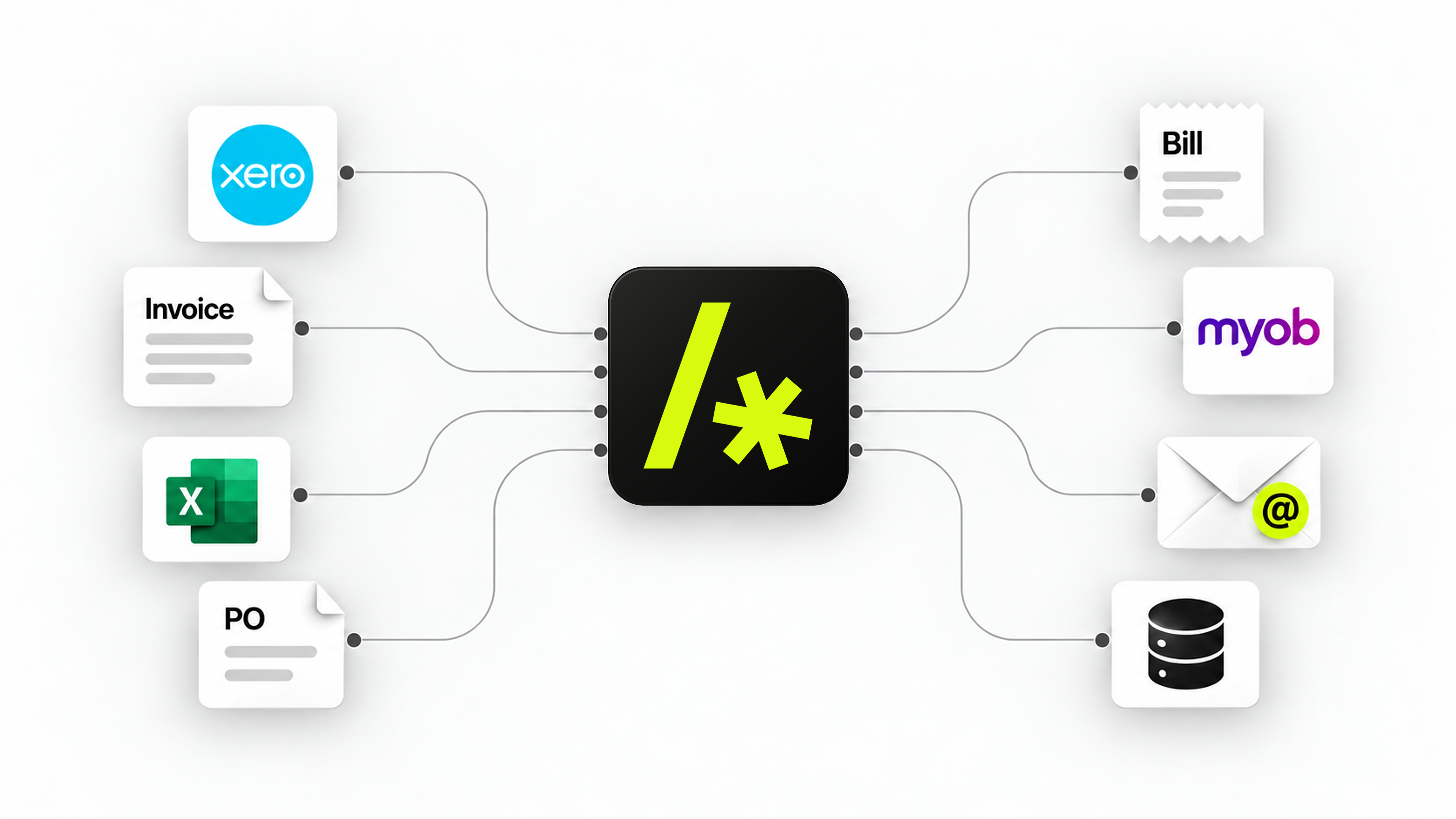
To ensure timely and accurate data, we create real time API syncs from your financial systems to feed data directly into your centralised database.
Connecting to these platforms, like Xero and MYOB, means that you never have to export another piece of data again to support your reporting. Our automation does all that work for you.
This API sync is coupled with a control centre which monitors the sync and allows you to make sure that it is successfully running.
How We Work
Step 1: Audit & Structural Discovery
Step 1 is critical - forming the foundation for what we actually end up building.
In this step, we work closely with your team to figure out three key things:
What financials do you need visibility on?
Who is the audience?
Where does the data currently live?
Step 2: Custom Architecture & Automation Build
Following discovery, we design and build a central database custom-tailored to your entity structure and reporting requirements. We then establish automated, real-time API integrations with your accounting platforms (such as Xero or MYOB) to continuously sync financial data without manual intervention.
Custom business logic, intercompany rules, standardisation of chat of accounts and and any additional logic are configured directly within the pipeline.
Finally, we deliver tailored user interfaces and reporting views - spanning P&L, balance sheets, and custom KPI dashboards - allowing leadership to instantly access accurate group performance data. This is all wrapped up in a custom web app for you and your team.
Step 3: Deployment, Validation & Handover
Before full rollout, we thoroughly test and validate the data syncs, reports and interface ensuring your team receives a great piece of custom software on day 1.
Once verified, we onboard key stakeholders, train your finance team on managing automated reporting flows, and configure any role based permissions that may be required.
We then turn to hyper-care mode for two weeks to ensure your new system is running smoothly, resolving any potential questions or issues that may come up.
After that point, we are available for a chat at any point if you would like to change or add to your new system. In our experience, customers regularly want to add additional reports, data sources and features into their platform. Once again, this is the beauty of owning a custom system - you own the direction!