Family Offices
One clear view across the entire family office
The Problem
Complex Structures, Limited Visibility
Family offices are rarely simple.
Over time, wealth is often spread across a large structure of companies, trusts, charities, property holdings, investment portfolios and other entities. Each one may have its own bank accounts, accounting systems, reporting requirements and ownership structures.
Individually, those entities may be relatively easy to understand. The difficulty comes when you need to see how everything is performing together.
Financial information often lives across multiple accounting platforms, spreadsheets, investment reports and property systems. That makes it difficult to get a clear and current picture of total wealth, cash flow, asset allocation, investment performance and the relationships between different entities.
It also makes comparison difficult. Different investments may have different start dates, cash flows, distributions and capital contributions, meaning a simple percentage return does not always tell you very much. Properly calculating annualised returns across those investments can become surprisingly complex, particularly when you want the numbers to be accurate and comparable.
Without a connected view, reporting can become a significant manual exercise, with people spending time collecting, reconciling and reshaping information before they can begin analysing it, and making decisions based on it.
As an additional consideration, family offices tend to be focussed on privacy and security as the information being managed is often highly sensitive, covering assets, ownership structures, investments and financial performance. Any system bringing that information together needs to be designed with security and confidentiality as a core requirement, rather than added as an afterthought, which is exactly how we build.
Our Solution
One View Across the Entire Family Office
Our solution is to build a custom system that brings the financial and operational information across the family office into one secure, connected view.
Rather than relying on a collection of spreadsheets and disconnected reports, we build around the actual structure of the family office - including companies, trusts, charities, properties, portfolios and other investment entities.
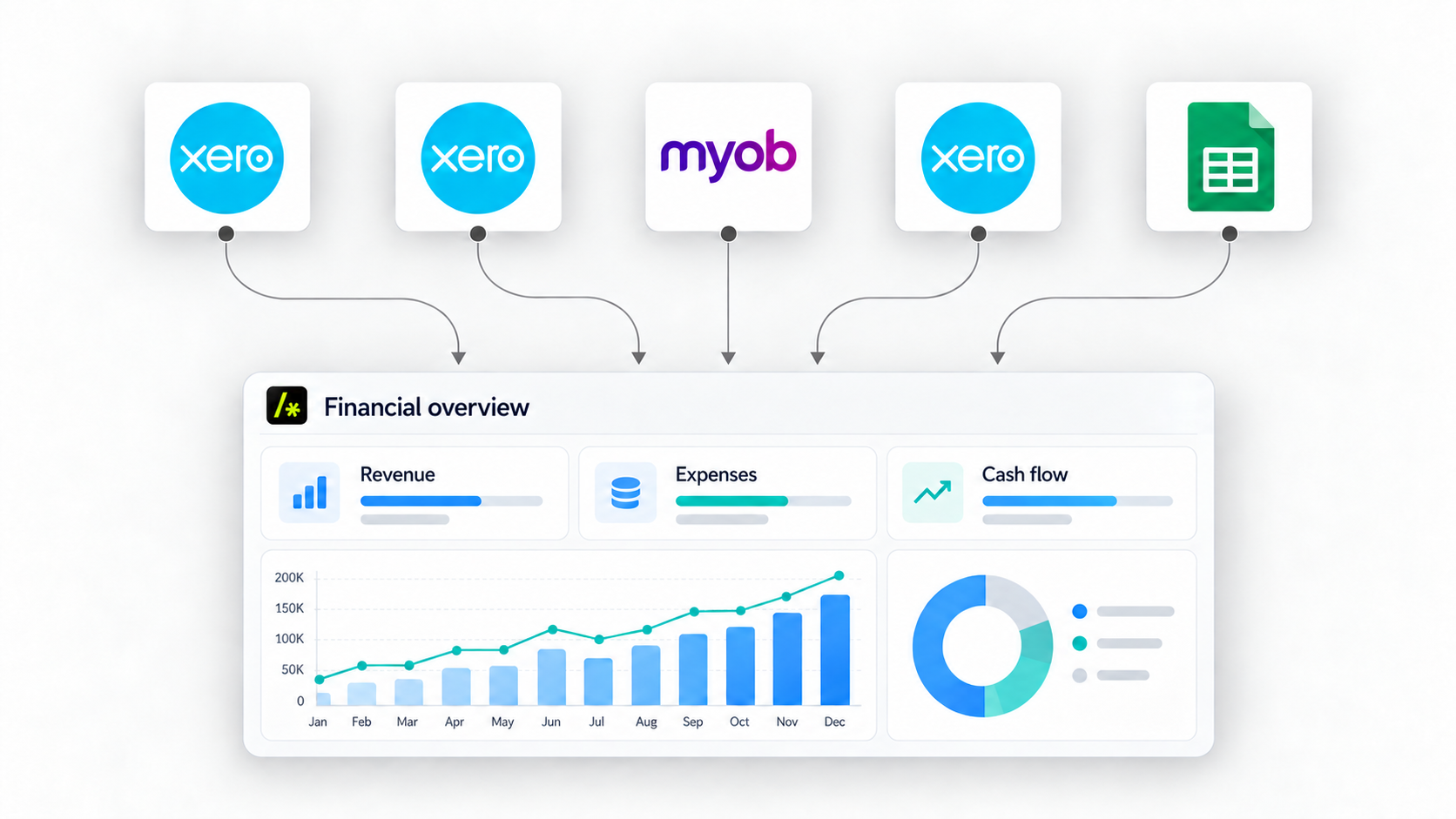
Information from accounting systems, investment platforms and other sources can be brought together and organised into a structure that reflects how the family office actually operates.
From there, the system can provide visibility at every level. Users can look at an individual asset or entity, review a particular investment category, or roll everything up into a consolidated view of the broader family office.
We also build the calculations required to properly compare investment performance. This includes annualised return calculations that account for the timing of investments, distributions and other cash flows, allowing very different investments to be assessed on a more consistent basis.
The result is a much clearer picture of where capital is allocated, how individual investments are performing, how the broader portfolio is changing over time, and where further attention may be required.
Because family office information is particularly sensitive, privacy and security are considered throughout the design of the system. Access can be structured around roles and responsibilities, sensitive information can be tightly controlled, and the overall architecture can be designed around the security requirements of the family and its advisers.
The goal is not simply to create another dashboard. It is to create a trusted financial system that gives the family office a consistent and accurate view of its assets and performance without compromising the privacy of the information behind it.
How We Work
Step 1: Audit & Structural Discovery
We start by understanding how the family office is structured and how information is currently managed.
That includes mapping the relevant companies, trusts, charities, properties, investment portfolios and other entities, along with the systems and data sources associated with each one.
We also look at how performance is currently measured, what reports are produced, where manual reconciliation is taking place, and which information different stakeholders need access to.
Security and privacy requirements are considered from the beginning. We identify who should be able to see what, how sensitive information should be handled, and any requirements around where data is stored or how it is accessed.
From there, we define the structure of the system, the integrations required and the reporting model that will sit across the family office.
Step 2: Custom Architecture & Automation Build
Once the structure is understood, we build the system around the family office itself.
This usually includes integrations with accounting platforms and investment data sources, consolidated reporting across entities, portfolio and asset views, historical reporting, cash flows, ownership structures and custom investment performance calculations.
Where investments need to be compared, we build annualised return calculations that properly account for different investment dates, contributions, withdrawals, dividends and distributions, creating a more consistent basis for performance analysis.
Throughout the build, we validate the system using real data and real reporting scenarios so that the finished product reflects the complexity of the family office rather than simplifying it away.
Step 3: Deployment, Validation & Handover
Before the system goes live, we validate the consolidated numbers against the family office's existing financial records and reporting.
That includes checking entity balances, ownership structures, investment values, cash flows and performance calculations to make sure the information being presented is accurate and consistent.
We also test permissions and access controls to ensure sensitive information is only visible to the appropriate people.
Once everything is ready, we deploy the system, help relevant users transition onto it, and provide the documentation and handover required for ongoing use.
The end result is a secure, purpose-built system that gives the family office a clearer view of its entire structure — from individual assets and investments through to consolidated performance across the whole portfolio.